
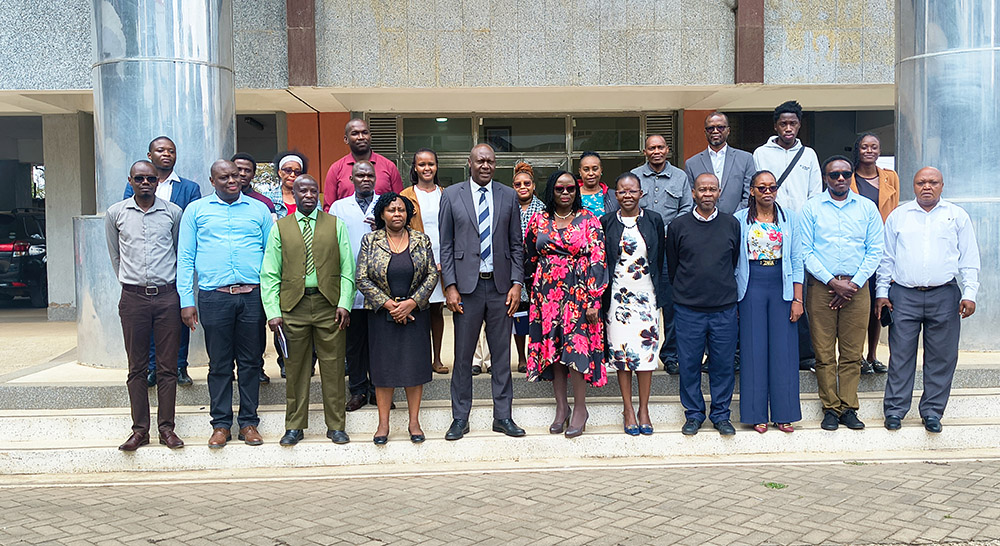
The Technical University of Kenya (TU-K) has officially launched CarboAI, an artificial intelligence-powered mobile application, designed to support dietary and lifestyle education for people living with type 2 diabetes. The launch was hosted on 30th August, 2026, at the University’s Redbull Restaurant.
The keynote speaker, Prof. Alfred Orina, Deputy Vice-Chancellor Research Technology and Development, called for the expansion of the newly launched CarboAI application across Africa, citing its potential to improve diabetes management through locally relevant data and interdisciplinary research.
"I am very excited about this project. Those of you who have taken care of a patient with diabetes know, that they may consume a small amount of food, and the next moment you hear the sugar has gone through the roof. Once we are able to capture the data extensively and use it to train the model, this project can be scaled-up to impact not just Kenya, but the entire African continent," he added.
The DVC noted that CarboAI, has been developed through collaboration between nutritionists, computer scientists and physicists, applauding the role of multidisciplinary research in addressing complex health challenges. He further challenged the research team and its partners to continue building on the innovation through sustained collaboration and capacity building.
Speaking during the launch, Prof. George Amollo, Dean, Faculty of Applied Sciences and Technology (FAST), said the research team received a US$60,000 compute grant through the Amazon Web Services (AWS) Global Health Equity Fund, enabling access to AWS cloud computing resources. He also acknowledged KENET for supporting students who participated in the project and thanked members of the research team for their contributions. "For us, our presence here is to celebrate that we have reached this far. We still have a lot of opportunities to explore," he said.
In her opening remarks, Dr. Janet Malla, a Lecturer of Human Nutrition and Dietetics in the Department of Health and Biomedical Science and the co-lead Nutrition expert in the app development, said the launch was not simply about introducing a mobile application but demonstrating how research can be translated into a practical solution that addresses a real public health challenge.
Dr. Michael Atambo, a Lecturer in the Department of Physics, Earth and Environmental Sciences and the software engineer behind the application, described the launch as an important milestone for everyone involved in developing CarboAI.
According to Dr. Atambo, while medication remains essential, many people living with diabetes struggle to understand the nutritional content of the foods they consume. He said CarboAI was developed to make nutrition knowledge more accessible by placing expert dietary guidance at users' fingertips.
"The future of health is not going to be governed by anything other than science, technology, innovation and, most importantly, cross-cutting collaboration between experts in nutrition, physics, computing and various other fields," he said.
During her presentation, Dr. Alice Ojwang, a Lecturer in the Department of Health and Biomedical Science, the lead Human Nutrition and Dietetics expert in the app development, described Carbohydrate Intelligence as a meal-planning approach that focuses on understanding total carbohydrate intake.
"It's really about getting to know your carbohydrates, where we highlight the total amount of carbohydrates that somebody consumes," said Dr. Ojwang.
Dr. Ojwang challenged common dietary habits that combine multiple carbohydrate-rich foods in a single meal, arguing that many people unknowingly consume excessive carbohydrates that contribute to poor blood sugar control.
She explained that the application uses artificial intelligence to analyse food images and estimate carbohydrate content, making nutrition education more accessible to the public. She emphasized that the application is intended to complement healthcare professionals rather than replace them.
Dr. Ojwang added that although the application is particularly useful for people living with diabetes, it can also help prevent the disease. "It can be used by everybody. Because if you're not diabetic now, and don't check your diet, you will be in a few years. So you can prevent diabetes by using the app now," she said.
She revealed that the team hopes to secure additional funding to improve the application, expand the food database, support postgraduate research, and incorporate educational features such as healthy cooking demonstrations and nutrition education videos.