The Vice-Chancellor Prof. Benedict Mutua has underscored TU-K’s commitment in remaining a premier institution in the training of hands-on professionals.
He emphasized that the model forms the basis of TU-K’s drive, to be the hub of technologists’ training within the region.
VC spoke this on Wednesday when he received a delegation of Pharmacy and Poisons Board (PPB) who paid him a courtesy call during their routine supportive supervision to the University.
Also present during the visit were the Dean, Faculty of Applied Sciences and Technology, Prof. George Amolo and Chairman Department of Health and Biomedical Sciences, Dr. Elizabeth Mwaniki.
PPB was conducting a routine inspection of the University and other institutions offering Pharmacy programmes.
Prof. Mutua noted that he was impressed with the inspection and collaboration since it will creates an academic environment that is responsive to societal needs. He emphasised the University’s effort in empowering the Department in four main areas; Human resource, Infrasture, Equipment and Curriculum Review.
VC further noted that Professional and Regulatory Bodies were key partners of the University since they help in raising the standards of teaching and training and therefore keeping the University compliant with the needs of the industry.
“We have strong collaboration with local industries to ensure that our training is aligned with the market needs. The University has recruited competent staff in the Department.”
The VC said staff development was a key agenda of his administration. He also added that the University has strived to acquire state of the-art-machines and equipment to boost its training.
“We therefore request your support in curriculum development to ensure it aligns with the requirements of the industry. Remember, we live in a dynamic world and we would appreciate if we see our graduates working in any part of the world.”
Dr. Siambi Kikete, PPB, Training and Assessment Technical Committee, noted that there was no better partnership than connecting science, engineering and entrepreneurship.
“We are happy to cooperate, put our energies together to strengthen the programmes and ensure training meets the needs of the society. I am available to offer pro-bono services to the Department.”
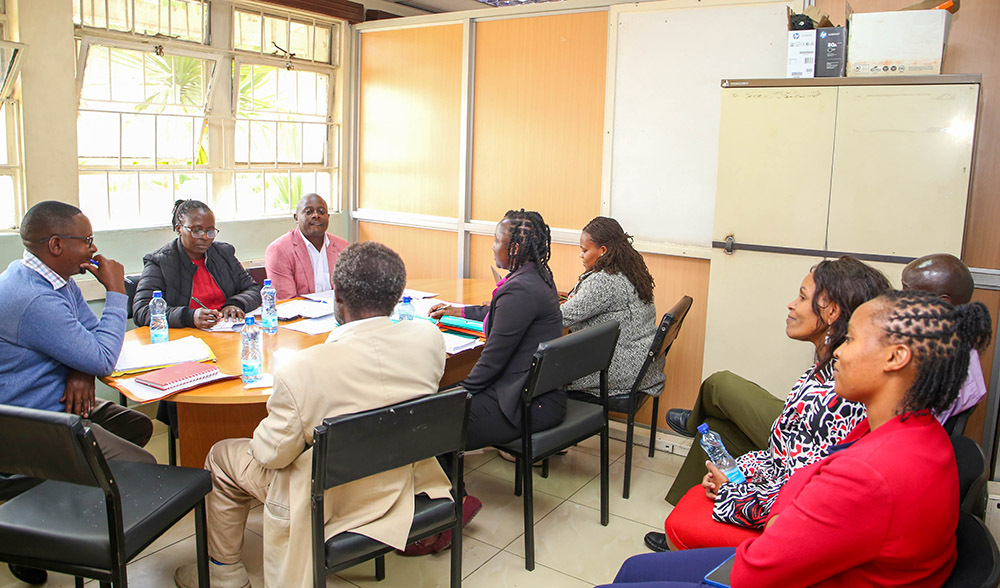
Kikete was accompanied by his counterpart Dr. Emily Chenebei. The team inspected the university laboratories and held discussions with the academic team.
The re-inspection established that the Diploma in Pharmacy programme had made progress in several areas, including governance, curriculum implementation, quality assurance, and student support services.
Dr. Mwaniki noted that the programme benefits from committed leadership, qualified staff, and institutional support. It was however established that improvements were still required in staffing levels, equipment acquisition, experiential learning, resource utilisation and strategic planning.
The inspection team encouraged the University to implement the recommendations provided and continue strengthening the programme to ensure full compliance with Pharmacy and Poisons Board standards and the delivery of high-quality pharmacy education and training.
The Department was represented by academic and administrative staff among them; Dr. Anne Mercy Adera, Dr. Issac Omwenga, Mr. Eliazar Kanan Ms. Rose Mathenge and Ms. Shirleen Minayo.
 Academic Calendar for Diploma and Undergraduate Students June – September Semester, 2026