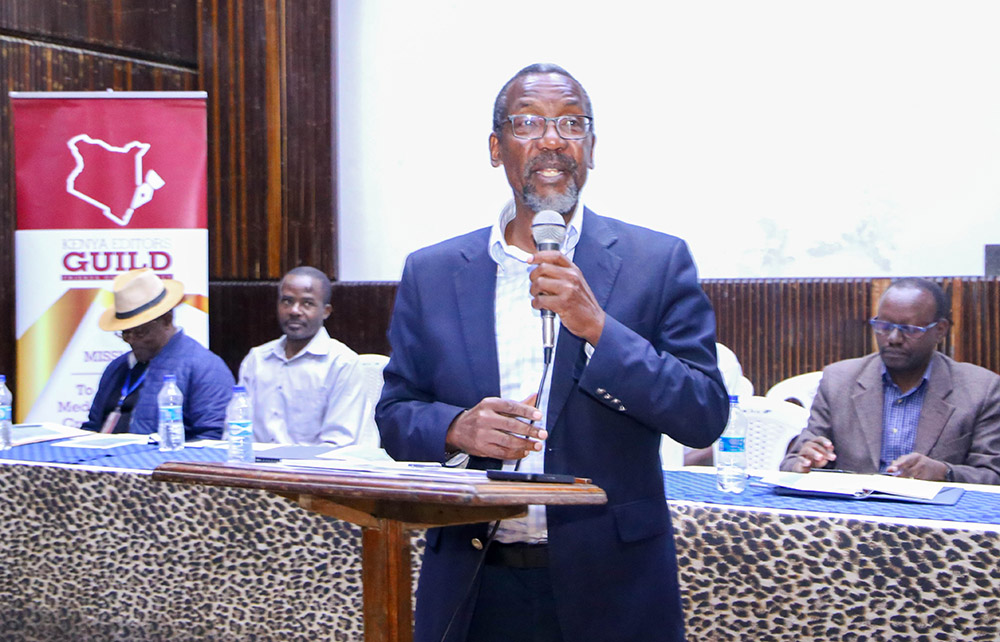
The Department of Creative Arts and Media, successfully hosted its Industry-Based Symposium for the 2025/2026 Academic Year, bringing together media industry leaders, alumni, lecturers, and students for insightful discussions on the future of journalism and communication in the digital era. The symposium was organised by the Department of Creative Arts and Media under the coordination of the Industry-Based Learning (IBL) Coordinator, Mr. Oketch Kendo, and supported by members of the academic staff. The department welcomed distinguished guests from the media industry who shared their expertise and experiences with students.
Held under the theme, “Nurturing Multimedia Skills for the Digital Era: Opportunities and Challenges,” the symposium provided a valuable platform for students to engage with seasoned media professionals and gain first-hand insights into the opportunities, innovations, and challenges shaping the contemporary media landscape. The forum also offered an avenue for meaningful dialogue on the skills and competencies required to succeed in an increasingly dynamic and technology-driven media environment.
The event attracted guests from the Media Council of Kenya (MCK), the Kenya Editors Guild (KEG), industry practitioners, alumni, and media students. Among the guests were the Chairman of the Media Council of Kenya, Mr. Maina Muiruri, veteran journalists Mr. Ken Bosire and Mr. Andy Kagwa, who represented the President Kenya Editors Guild Ms. Zubeidah Kananu and Chief Executive Officer of Kenya Editors Guild, Ms Linda Bach respectively.
Speaking during the opening session, the Chairperson of the Department of Creative Arts and Media, Dr. Mary Kidenda, welcomed the guests and emphasised the importance of strengthening collaboration between academia and industry to prepare students for the rapidly evolving media environment.
Dr. Kidenda noted that technological advancements have fundamentally transformed how information is created, distributed, consumed, and verified. She observed that modern media professionals are expected to possess a wide range of skills beyond traditional reporting, including multimedia storytelling, digital content creation, data analysis, videography, photography, social media management, and audience engagement.
“The media profession today demands versatility, adaptability, ethical responsibility, and technological competence. Industry engagement is critical in bridging the gap between classroom learning and professional practice.”
She further challenged students to remain committed to the timeless values of journalism that are truth, accuracy, integrity, accountability, and public service, despite the rapidly changing technological landscape.
Mr. Muiruri highlighted the role of the Media Council of Kenya in regulating and supporting the media industry. He encouraged students to take advantage of accreditation opportunities, internships, and mentorship programmes offered through the Council as they prepare for their careers.
Mr. Muiruri underscored the transformative impact of digital technologies on journalism, noting that the digital era has expanded opportunities for content creation, audience engagement, entrepreneurship, and independent media production.
“The digital age should not be feared, rather it should be embraced. Young media professionals today have unprecedented opportunities to create content, build personal brands, establish media platforms, and reach audiences globally through digital technologies.”
He also urged students to leverage emerging technologies such as Artificial Intelligence (AI), mobile journalism, and digital publishing while upholding ethical standards and combating misinformation and disinformation.
The symposium featured engaging presentations and panel discussions by veteran media professionals from the Kenya Editors Guild, who shared practical experiences from their careers and discussed the changing realities of the newsroom.
Mr. Bosire encouraged students to cultivate strong writing, critical thinking, and communication skills, emphasising that journalism remains a knowledge-driven profession despite technological disruptions.
He challenged aspiring journalists to develop a passion for continuous learning, noting that professional success is built on curiosity, discipline, and a commitment to storytelling that serves the public interest.
The discussions also explored the growing career opportunities available to communication graduates beyond traditional newsrooms. Participants were encouraged to explore emerging fields such as digital content creation, podcasting, mobile journalism, data journalism, fact-checking, strategic communication, corporate communications, public relations, film production, and multimedia storytelling.
The symposium further benefited from the participation of TU-K alumnus Mr. Adonija Ndege, who shared his career journey and experiences navigating the media industry. His success story inspired students and demonstrated the diverse opportunities available to graduates equipped with the right skills and mind-set.
A recurring message throughout the symposium was the need for students to embrace innovation, continuously upgrade their skills, and position themselves as solution-oriented professionals capable of thriving in an increasingly competitive and technology-driven industry.
The participants reaffirmed the importance of stronger partnerships between universities and industry stakeholders in enhancing experiential learning and preparing graduates for the demands of the modern workplace.
The event underscored TU-K’s commitment to producing industry-ready graduates equipped with the knowledge, practical skills, and ethical grounding necessary to excel in the digital era while contributing meaningfully to the growth of Kenya’s media and communication sector.
 Academic Calendar for Diploma and Undergraduate Students June – September Semester, 2026