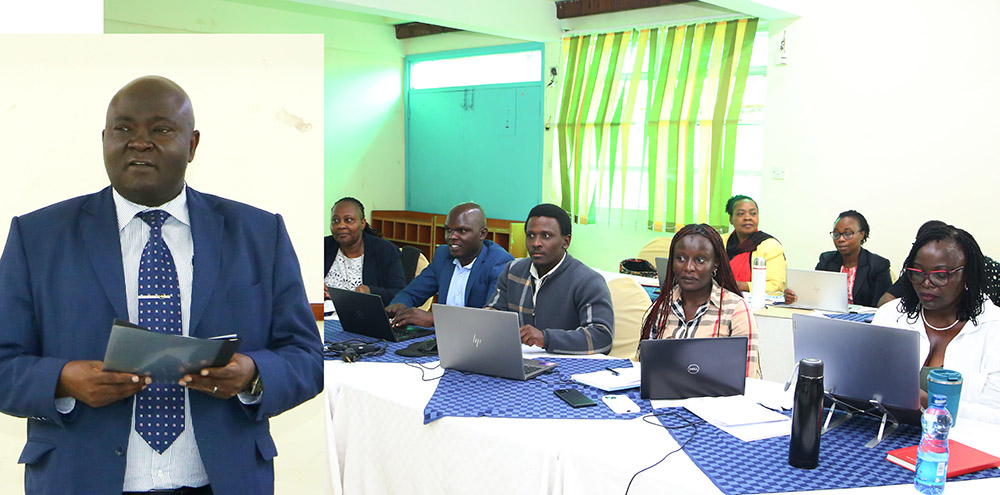
The Faculty of Applied Sciences and Technology, Department of Health and Biomedical Sciences is hosting a 5-day training on the Integrated Food Security Phase Classification for Acute Malnutrition (IPC-AMN), aimed to sensitise members of faculty on IPC systems and promote the integration of IPC curriculum within higher education.
In a keynote address, the Deputy Vice-Chancellor, Academic and Student Affairs, Prof. Maurice Amutabi, reaffirmed the TUK’s commitment to producing globally-competent graduates who can provide solutions to local problems. The DVC, further underscored the need to embed IPC knowledge within teaching, research, and community engagement frameworks, noting that such integration is critical in addressing the dual burden of malnutrition and strengthening evidence-based decision-making across Kenya and the region.
“At TU-K, we are committed to producing graduates who possess not only theoretical knowledge but also practical, and globally recognised technical skills. This training will ensure that our institution contributes meaningfully to national and regional efforts in combating food insecurity and malnutrition.”
Additionally, he emphasised that the significance of the engagement extends beyond the training venue, pointing to its broader humanitarian impact.
“The importance of this session extends beyond this hall. The expertise acquired here will ultimately benefit the communities and populations that depend on accurate data and timely interventions for their survival and well-being.”
Executive Dean, Faculty of Applied Sciences and Technology (FAST), Prof. George Amollo, emphasised the importance of interdisciplinary collaboration and applied problem-solving in addressing complex global challenges such as food insecurity and malnutrition.
“The challenges of food insecurity and malnutrition cannot be addressed through theory alone. They require professionals who can analyse evidence, work across disciplines, and develop practical solutions that improve lives.”
He urged participants to view the training as a platform for strengthening analytical and problem-solving capacities rather than a purely technical exercise.
“The true value of this programme lies in its ability to empower participants to identify problems, interpret data accurately, and translate that knowledge into action. Every crisis presents an opportunity for innovation, and universities have a responsibility to nurture graduates who are solution-oriented.”
The training is being facilitated by a team, led by Dr Judith Munga, IPC Nutrition Consultant.The IPC-AMN framework is a globally recognised system used to classify the severity and drivers of acute malnutrition. It provides governments, humanitarian agencies, and development partners with standardised evidence to guide emergency response, policy formulation, and resource allocation.
 Academic Calendar for Diploma and Undergraduate Students June – September Semester, 2026