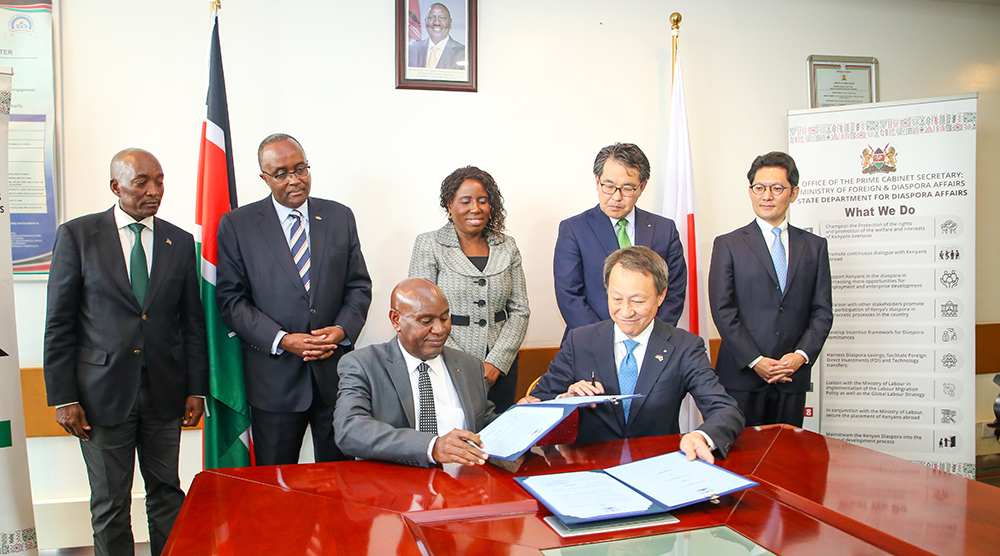
TUK, University of Nairobi (UoN), and Japan’s Shimizu Corporation have today signed a Memorandum of Understanding (MoU) aimed at strengthening collaboration in human resource development in the construction and engineering sectors. The agreement seeks to enhance skills in engineering education, develop globally competitive talent, and expand opportunities for Kenyan graduates through structured international industry pathways.
The partnership, unveiled during a high-level ceremony attended by government officials, diplomats, university leadership, and industry representatives, marks a significant milestone in Kenya–Japan cooperation in higher education and infrastructure development.
In his opening remarks, Amb. Isaiya Kabira, Secretary for Diaspora Investments, Skills, and Entrepreneurship, State Department for Diaspora Affairs who represented the Principal Secretary Ms. Roseline K. Njogu, underscored the importance of the agreement in advancing Kenya’s labour mobility and skills development agenda.
“This event represents much more than the signing of a cooperation agreement,” he said. “It marks a significant milestone in advancing Kenya–Japan labour mobility and demonstrates our shared commitment to investing in skills, talent development, innovation and sustainable economic growth.”
The keynote speaker, the Principal Secretary for Higher Education and Research, Dr. Beatrice Inyangala, described the agreement as a strategic investment in the future of Kenya’s workforce.
“Today’s signing represents a shared vision of the future. It creates a platform through which Kenya’s engineers, technicians and other skilled professionals can access opportunities across the global operations and partnerships of Shimizu Corporation,” stressed PS Inyangala.
She emphasised that the MoU goes beyond institutional cooperation, calling it a framework for internationalising Kenya’s skills base. She expressed confidence in the impact of the collaboration, stating that it would strengthen global competitiveness and deepen bilateral ties.
“We are confident that this collaboration will contribute to the development of globally competitive talent, facilitate the transfer of knowledge and technology, and deepen the people-to-people ties that underpin the strong friendships between Kenya and Japan,” she added.
Mr. Hitosh Fujita, Director, Global Business, Shimizu Corporation, noted that the agreement reflects a long-term commitment to Africa’s infrastructure transformation and talent development. He further stated that the company seeks to position Nairobi as its African operational hub.
“We hold immense expectations for the growth potential of the African continent, and especially for Kenya, a country brimming with vitality and progress as its central hub. With this, we have made the decision to open a new office here in Nairobi as a base of operations in Africa,” he said.
He added that Shimizu aims to act as ‘a true partner in building the future’ combining technological expertise with local capacity building.
Central to the partnership is an expanded Shimizu Academy model, designed to cultivate the next generation of professional construction managers who will support Africa’s infrastructure development.
Mr. Kenzo Matsumoto, the Human Resource Group Leader for Civil Engineering at Shimizu Corporation, underscored the company’s philosophy of contributing to a sustainable future through international collaboration.
“The world faces unprecedented challenges; climate change, energy shortages, and food security issues. We believe we must look beyond Japan,” he said.
He further stressed that the company’s contribution is not only physical infrastructure but also human empowerment.
“We believe our ultimate social contribution is not just to build structures, but to empower people,” Mr. Matsumoto said.
“By transferring our technology through the development of human resources, we enable young African professionals to become world-class engineers,” he added.
Amb. Moi Lemoshira, Ambassodor, Embassy of the Republic of Kenya in Japan also welcomed the agreement, noting its importance in strengthening bilateral cooperation following high-level engagements under TICAD 9 and ongoing Japan–Africa collaboration frameworks.
“The interconnectivity between people will be central to this future partnership. This MoU underlines the importance of people-to-people interaction, technology transfer, and exchange programmes between our two countries,” Amb Lemoshira said.
Under the programme, graduates from TU-K and UoN in architecture and civil engineering will be recruited into a structured training pipeline. Selected candidates will first undertake a free one-year Japanese language course in Kenya. High-performing trainees will then be invited to Japan for on-site construction management training, gaining hands-on experience at Shimizu’s active project sites.
“Once students master the language, Shimizu will hire them as full-time employees,” Mr. Matsumoto explained. “They will then travel to Japan to undergo several years of practical training as site managers.”
Upon completion, graduates are expected to return to their home countries as highly-skilled professionals, strengthening Kenya’s engineering capacity while expanding Shimizu Corporation’s human resource base across Africa. This long-term model ensures participants become “vital assets” in advancing infrastructure development and supporting the company’s regional operations.
TU-K VC, Prof. Benedict Mutua, said the partnership marked a turning point in aligning academic training with industry needs. “This collaboration is timely and strategic. It strengthens our ability to produce graduates who are not only academically strong but also globally competitive and industry-ready. It is a model that bridges the gap between classroom learning and real-world engineering practice.”
UoN VC, Prof. Ayub Gitau, echoed these sentiments, noting that the MoU reinforces the university’s internationalization agenda. “This partnership opens new frontiers for our students and faculty by expanding opportunities for mobility, research collaboration, and skills development. Most importantly, it ensures our graduates are prepared to contribute meaningfully to global infrastructure challenges.”
The MoU positions TU-K and UoN as key partners in building globally competitive engineers while deepening Kenya–Japan collaboration in education, innovation, and infrastructure development.
 Academic Calendar for Diploma and Undergraduate Students June – September Semester, 2026