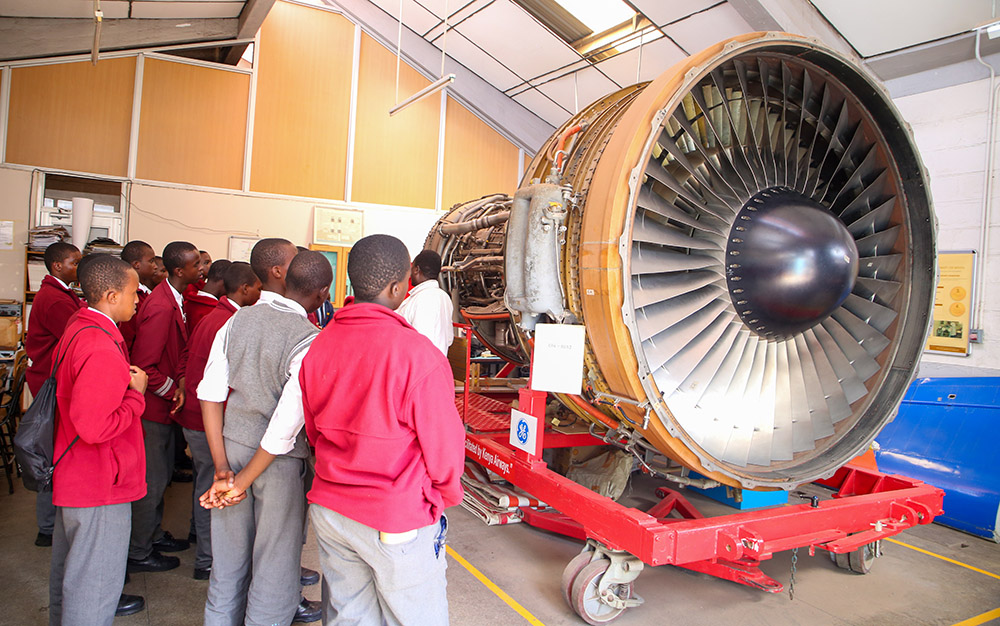
Machakos School Grade 10 students were excited to interact with the practical aspects of propulsion technology and aerospace engineering. The students, who are the first cohort of Competency-Based Education (CBE) curriculum enrolled in the science pathway with an elective in Aviation Technology, on May 22, 2026, toured TU-K’s propulsion laboratories and aeronautical simulation laboratories as part of their academic excursion.
They were received by the Chairman of the Department of Mechanical and Aerospace Engineering, Dr. Fredrick Mutua. The students were taken through functionalities and components of aircraft engine, turbine systems, compressors and aviation procedures, while also being encouraged to ask questions on practical scenarios beyond theoretical knowledge.
The group comprised 104 Grade 10 Aviation Technology students accompanied by three teachers who included; Mrs. Caroline Mutuku and Mr. Simeon Onyona and Mr. Hillary Jarega.
The students also toured other engineering facilities within the university, including; Conventional and Advanced Engineering (CNC) workshops.
Speaking during the visit, Mr. Jarega said TU-K was deliberately selected because of its engineering facilities and ability to provide firsthand exposure to aviation systems.
Having studied at this institution, he noted that he understood the kind of exposure the learners required, particularly within the propulsion and mechanical laboratories, where students could closely observe aviation concepts in practice. He explained that, unlike the previous 8-4-4 system, the current curriculum requires students to combine theory with practical experience.
“The expectation is that, the students would learn about the different components of the engine, this then help in internalizing theoretical knowledge I teach in the classroom,” he added.
He noted that; CBE learning focuses on understanding concepts through observation,
experimentation and engagement rather than relying entirely on theoretical instruction.
He added that exposing the young learners to technical environments at an early stage would help them develop industry awareness and practical understanding long before joining university.
Some students, for instance, sought to understand how introducing foreign structures such as mesh near engine systems could affect aircraft performance, allowing instructors to explain the relationship between aircraft design, engine efficiency and safety procedures in aviation.
Mr. Onyona, further explained that the CBE curriculum has introduced a major shift in career development among learners. Out of a Grade 10 population of 967 students at Machakos School, 123 students initially selected Aviation Technology before the number settled at 104.
 Academic Calendar for Diploma and Undergraduate Students June – September Semester, 2026