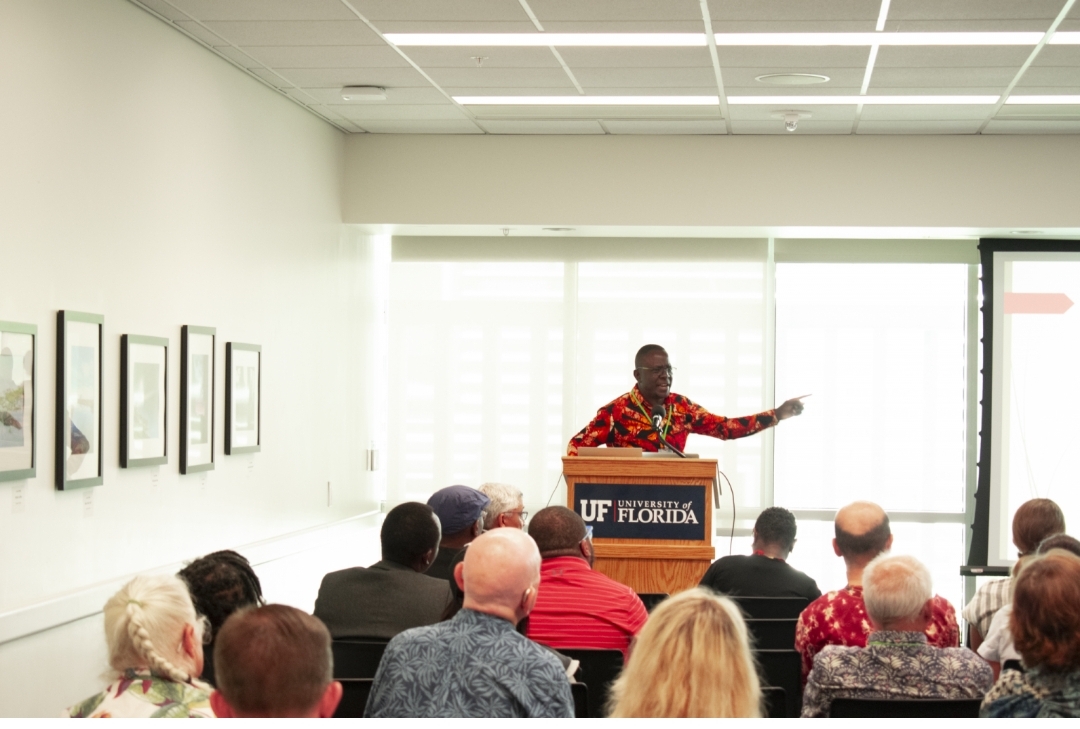
Rivers play a critical role in knowledge systems, peoples’ identity, cultural memory and environmental stewardship. This was the central argument advanced by Dr. Mukasa Wafula from the Department of Music and Performing Arts who presented this discourse at an International Conference held at the University of Florida, USA.
Dr. Wafula was joined by fellow panellists Dr. Abdoulaye Kane from the University of Florida and Dr. Ndubuisi Ezeluomba, Curator of African Arts at the Virginia Museum of Fine Arts. Together, they made presentations under the sub-thematic area – ‘Sacred Waters: Belief, Migration, and Cultural Memory’.
Their discussions highlighted the centrality of water bodies in the continent’s historical and contemporary political, social and cultural expression, forming a discussion on the interdisciplinary analysis of water’s role in African environment and societies.
The conference themed: ‘Ecologies and Identities in Africa’s Lakes, Rivers, and Oceans’, brought together leading researchers across a wide range of disciplines – in sciences, social sciences, arts and humanities.
Water has often been invisible or taken for granted in scientific studies focused on land use, conservation, urbanization and conflict, yet its value as a scare resource across much of the continent has always been appreciated by people – reads part of the conference excerpt.
In his paper, Dr. Wafula demonstrated how rivers are regarded as dynamic knowledge systems that shape and sustain identity, cultural memory, spiritual meaning and practices of environmental stewardship. His study was based on the experiences of the Bukusu community of Western Kenya.
He noted that water forms the basis for decision making in agriculture, healthcare, food preparation, education, natural resources and other community activities including the Bukusu initiation ceremony conducted within river ecologies.
African rivers function as repositories of ecological, spiritual, and cultural knowledge passed down through generations; this is however with respect to people’s attachment of value to its facets.
Dr. Mukasa cited the important role that traditional belief systems, taboos and superstition play in embedding conservation principles. These include prohibition of farming activities along river banks, harvesting of sand, cutting of trees around river banks among others.
He further highlighted several contemporary threats to loss of river knowledge among them urbanisation, the influence of religion, the loss of oral tradition and climate change – all which have the potential to significantly alter river ecosystems, affecting the communities that depend on them.
Other sub-thematic areas of discussion in the conference included;
- African Waters at Risk: Climate, Governance, and the Future of African Freshwaters
- Water and Power: Infrastructure, Empire, and Development
- Urban Waters, Invisible Threats: Waste, Toxics, and Diseases
- Life in the Balance: Biodiversity, Contaminants, and Conservation
 Academic Calendar for Diploma and Undergraduate Students June – September Semester, 2026